

Understanding Outpatient Treatment for Addiction
Outpatient Treatment for Addiction is a critical topic in addiction treatment and recovery. According to the Substance Abuse and Mental Health Services Administration (SAMHSA), millions of Americans are affected by substance use disorders each year, and understanding the various dimensions of treatment, including this topic, is essential for informed decision-making about care options.
The landscape of addiction treatment has evolved dramatically over the past two decades. What was once a field dominated by a single approach has become a sophisticated, evidence-based medical discipline that recognizes the biological, psychological, and social dimensions of substance use disorders. This evolution means more options, better outcomes, and greater hope for individuals and families navigating the recovery journey.
This comprehensive guide examines the key aspects of this subject, drawing on current research from the National Institute on Drug Abuse, Centers for Disease Control and Prevention, and American Society of Addiction Medicine. Whether you are exploring options for yourself or supporting a loved one, the information here will help you understand what to expect, what questions to ask, and how to make informed decisions about treatment.

The Three Levels of Outpatient Treatment
Outpatient treatment means you live at home and travel to the program. What changes between levels is how many hours a week you spend there.
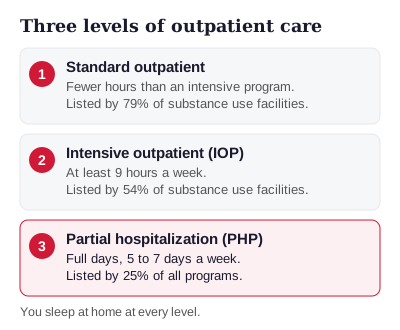
| Level | Time commitment | Programs that list it |
|---|---|---|
| Standard outpatient | Fewer hours than an intensive program | 79% |
| Intensive outpatient program (IOP) | At least 9 hours a week, commonly three 3-hour sessions | 54% |
| Partial hospitalization (PHP) or day treatment | Full-day schedules, 5 to 7 days a week | 25% |
Hours for IOP and day treatment are from a review in Psychiatric Services (McCarty et al., 2014). Program shares are our count, described below: standard outpatient and IOP out of the 7,756 substance use treatment facilities, the only ones SAMHSA asks about them; PHP or day treatment out of all 14,140 programs, since both questionnaires ask about it.
IOP vs PHP
Both keep you at home at night. An intensive outpatient program takes three half-days or evenings a week, which leaves room for a job or school. Partial hospitalization takes the whole day, most days of the week, and is the most intensive option short of a bed. The review describes day treatment as operating "full-day schedules 5 to 7 days per week".
Outpatient vs inpatient rehab
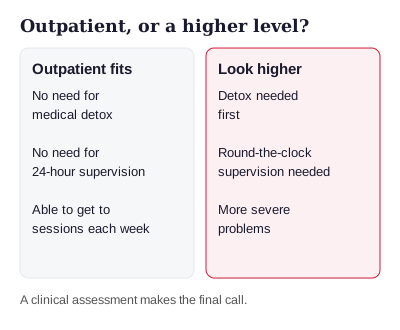
Inpatient and residential programs provide 24-hour supervision and a bed. Outpatient programs do not. According to the review, intensive outpatient programs are for people "who do not require medical detoxification or 24-hour supervision". That sentence is the dividing line.
What a Week in Outpatient Treatment Looks Like
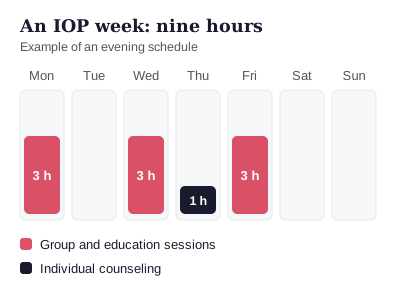
An intensive outpatient program delivers, in the review's words, "a minimum of 9 hours of service per week in three, 3-hour sessions". The core services SAMHSA expects are individual, group and family therapy, and education about substance use and mental health.
An example IOP schedule
| Day | Example of an evening IOP week |
|---|---|
| Monday | 6 to 9 p.m.: skills group, then education session |
| Wednesday | 6 to 9 p.m.: process group, then relapse prevention |
| Thursday | One hour with your individual counselor |
| Friday | 6 to 9 p.m.: group, then family session or weekend planning |
An illustration of how nine hours can be arranged. Real schedules differ by program.
How long outpatient treatment lasts
There is no fixed term. The review notes that "many programs become less intensive over time" and that progress, "rather than a predetermined length of stay", decides when a person moves on. As a rough guide, in a cost study of 110 programs the average stay was 12 weeks in intensive outpatient care and 18 weeks in standard outpatient care.

Does Outpatient Treatment Work as Well as Inpatient?
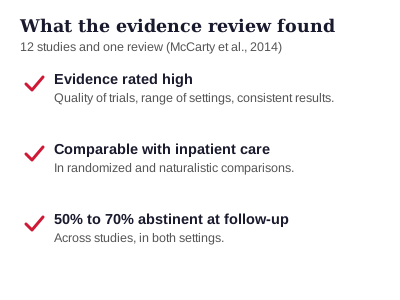
For most people, yes. The review looked at 12 studies and one earlier review and rated the evidence for intensive outpatient programs as high. Its findings:
- "Multiple randomized trials and naturalistic analyses that compared IOPs with inpatient or residential care found comparable outcomes."
- Across studies, "50% to 70% of their participants reported abstinence at follow-up", and in most studies that figure did not differ between inpatient and outpatient care.
- The authors' conclusion: intensive outpatient programs "are as effective as inpatient treatment for most individuals".
The advantages of staying at home
The review names two. Treatment can last longer, and people are treated "while they remain in their home environments", which gives them the chance "to practice newly-learned behaviors". A skill learned on Tuesday gets tested on Tuesday night.
When outpatient is not enough
"Most individuals" is not everyone. One of the studies in the review found that people with more severe problems did better after long-term residential care than after short-term care. Severity, not preference, should decide the level.
Who Outpatient Treatment Is For
Two questions settle most cases. Do you need medical detox first? Do you need someone awake and nearby around the clock? If both answers are no, outpatient care is a reasonable place to start.
Detox first, then outpatient
If you may need detox, start there: our guide to the detox process explains what it involves. Outpatient programs are also where people go next. The review describes them as allowing participants "to avoid or step down successfully from inpatient services". One path is residential care, then an intensive outpatient program, then standard outpatient visits.
How Many Programs Offer Each Level
Outpatient care is the backbone of the system. Of the 14,140 programs with a SAMHSA profile in our directory, 12,263 offer outpatient treatment. That is 87%, and for 10,948 of them it is the only setting.
SAMHSA asks about standard and intensive outpatient care only on its questionnaire for substance use treatment facilities, so those rows count the 7,756 facilities that answered it. Partial hospitalization is asked on both questionnaires and is counted among all programs.
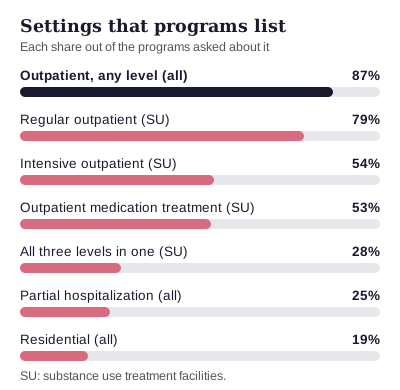
| Listed in the SAMHSA profile | Programs | Share |
|---|---|---|
| Outpatient, any level (all 14,140 programs) | 12,263 | 87% |
| Outpatient only, no beds (all 14,140) | 10,948 | 77% |
| Regular outpatient treatment (7,756 substance use facilities) | 6,111 | 79% |
| Intensive outpatient treatment (7,756) | 4,158 | 54% |
| Outpatient medication treatment for opioid use (7,756) | 4,102 | 53% |
| All three outpatient levels in one facility (7,756) | 2,203 | 28% |
| Partial hospitalization or day treatment (all 14,140) | 3,570 | 25% |
| Outpatient and residential in one program (all 14,140) | 1,048 | 7% |
Why the last two rows matter
Moving between levels is simpler when you do not have to change providers. Only 28% of substance use treatment facilities offer standard, intensive and day treatment together, and only 7% of all programs offer both residential and outpatient care. If you expect to move between levels, look for one of these or ask how the handover to another provider is arranged.
IOP and PHP by state
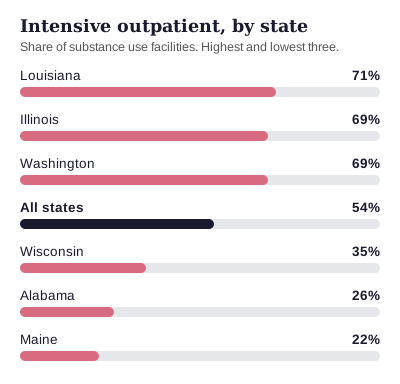
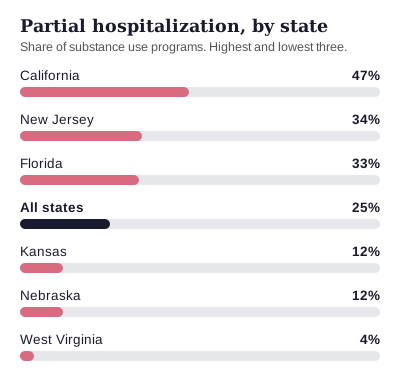
Intensive outpatient treatment is listed by 71% of substance use facilities in Louisiana and 69% in Illinois and Washington, against 26% in Alabama and 22% in Maine. Partial hospitalization, counted among all programs, varies just as much: 47% in California and 34% in New Jersey, against 12% in Nebraska and 4% in West Virginia.
Telehealth and Medicaid
Among programs with outpatient care, 88% also list telehealth therapy and 83% list Medicaid. For intensive outpatient programs the Medicaid share is 77%.
Method: Pathway Recovery editorial team. Source is the service profile each facility files with the SAMHSA Treatment Services Locator (FindTreatment.gov). SAMHSA uses two questionnaires; each share is out of the programs that answered the questionnaire asking about that setting: 7,756 substance use treatment facilities, or all 14,140 programs when both ask. A program is counted when the setting appears in its profile word for word. Corrected October 16, 2026: an earlier version divided every count by all 14,140 programs, which understated standard outpatient, IOP and the three-level figure by up to half.
You can check which levels a facility reports on its page in our state directory. For a shorter overview of each level, see outpatient treatment and intensive outpatient programs.
What Outpatient Treatment Costs
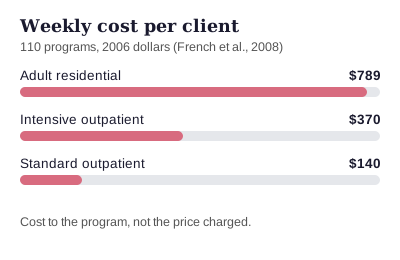
Much less per week than residential care. In an economic study of 110 programs, the average cost per client was $140 a week for standard outpatient treatment and $370 for intensive outpatient treatment, against $789 for adult residential care (French et al., 2008). Those figures are in 2006 dollars and describe what the program spends, not what it charges, so use them for the ratio and not the price.
How programs are paid, and what to do without insurance, is covered in our article on the cost of addiction treatment.
Questions to ask an outpatient program
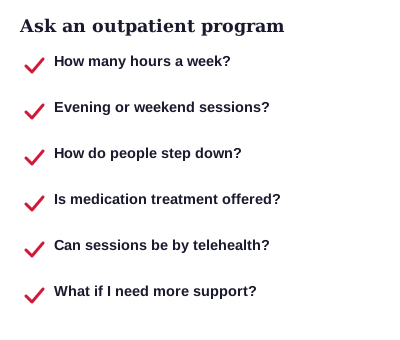
- How many hours a week, and on which days?
- Are there evening or weekend sessions?
- How and when do people step down to fewer hours?
- Is medication treatment available here?
- Can some sessions be done by telehealth?
- What happens if I need more support than outpatient care gives?
The Evidence Base: What Research Tells Us
Modern addiction treatment is grounded in decades of clinical research. Randomized controlled trials, longitudinal outcome studies, and real-world effectiveness data have established clear evidence for what works, and what doesn't, in treating substance use disorders. Understanding this evidence helps individuals and families evaluate treatment options critically and choose programs most likely to produce lasting results.
The NIDA Principles of Drug Addiction Treatment identifies several key evidence-based findings: addiction is a complex but treatable brain disorder; no single treatment is appropriate for everyone; treatment needs to be readily available and retained for an adequate period of time; effective treatment addresses multiple needs beyond substance use; medications are an important element of treatment for many patients; behavioral therapies including CBT are the most commonly used forms of addiction treatment; and treatment must be monitored and modified as necessary.
These principles inform best practices across all treatment settings and substance types. Programs that align with these evidence-based principles consistently produce better outcomes than those relying on unvalidated approaches, ideology, or tradition alone. When evaluating treatment options, ask specifically how the program incorporates these research-backed principles into its clinical programming.
Need Help Finding Treatment?
Our counselors are available 24/7 to help you find the right program.
Practical Considerations and What to Expect
Navigating the practical aspects of treatment can feel overwhelming, but understanding common processes and expectations reduces anxiety and facilitates better decision-making. Whether you are considering residential treatment, outpatient programs, or other care options, several universal practical considerations apply.
Assessment and intake: Quality treatment programs begin with a comprehensive assessment that evaluates substance use history, medical conditions, psychiatric symptoms, social circumstances, and treatment goals. This assessment informs an individualized treatment plan tailored to your specific needs, not a one-size-fits-all curriculum.
Duration of treatment: Research consistently shows that longer treatment engagement produces better outcomes. The National Institute on Drug Abuse recommends a minimum of 90 days for most treatment modalities. However, treatment duration should be based on individual progress rather than arbitrary timelines. Some individuals benefit from 6-12 months or longer of structured care, particularly when co-occurring conditions complicate recovery.
Insurance and cost: Most insurance plans cover addiction treatment under federal parity laws. The treatment center's admissions team can verify your specific benefits and help you understand expected costs. Financial concerns should not prevent you from seeking treatment, numerous options exist for individuals at every income level.
Family involvement: Family participation significantly improves treatment outcomes. Most quality programs offer family therapy, education sessions, and support for loved ones. Engaging family members early in the treatment process builds the supportive home environment that sustains long-term recovery.
Treatment Approaches and Therapeutic Methods
Effective treatment for substance use disorders employs multiple evidence-based therapeutic approaches, typically combined within a comprehensive treatment plan. Understanding the major modalities helps you evaluate programs and participate more actively in your own care.
Cognitive-Behavioral Therapy (CBT) helps individuals identify the thoughts, beliefs, and behavioral patterns that drive substance use. By learning to recognize triggers, challenge distorted thinking, and develop healthier coping strategies, clients build skills that serve them throughout recovery. CBT has one of the strongest evidence bases of any addiction treatment modality.
Motivational Interviewing (MI) is a collaborative conversation style that strengthens a person's own motivation for change. Rather than telling someone what they should do, MI helps individuals articulate their own reasons for wanting recovery and resolve ambivalence about change. This approach is particularly effective in early treatment when motivation may be fragile.
Group therapy provides peer support, accountability, shared learning, and the experience of being understood by others facing similar challenges. Most treatment programs incorporate group therapy as a central element, with groups focused on various topics including relapse prevention, coping skills, trauma processing, and life skills development.
12-step and mutual aid programs including AA, NA, and SMART Recovery provide ongoing peer support that extends well beyond formal treatment. These programs are freely available, widely accessible, and provide a framework for sustained recovery that millions of people have found invaluable.
Holistic and complementary approaches including mindfulness meditation, exercise therapy, nutritional counseling, yoga, art therapy, and equine therapy can complement evidence-based treatments. While these approaches should not replace core therapies, they can enhance overall wellbeing and provide additional tools for managing stress and emotions in recovery.
Building Long-Term Recovery
Completing a treatment program is a crucial milestone, but sustained recovery requires ongoing effort, support, and vigilance. Research published in the Journal of Substance Abuse Treatment demonstrates that the first year following treatment completion is the highest-risk period for relapse, with risk decreasing significantly after five years of sustained sobriety. Building a robust recovery support system during and after treatment is essential.
Aftercare planning should begin well before treatment discharge. A comprehensive aftercare plan includes: ongoing therapy (individual and/or group), medication management if applicable, support group participation, sober living arrangements if needed, employment or educational support, family therapy, recreational and social activities that support sobriety, and a written relapse prevention plan with specific triggers, coping strategies, and emergency contacts.
Lifestyle changes form the foundation of sustainable recovery. Regular physical exercise reduces cravings and improves mood. Proper nutrition supports brain healing. Adequate sleep restores cognitive function and emotional regulation. Mindfulness practices build awareness and stress tolerance. These lifestyle elements are not "nice to have" additions, they are evidence-based recovery tools with documented effectiveness.
Meaningful connection, with a sponsor, therapist, support group, family, and sober friends, provides the social scaffolding that sustains recovery through difficult times. Isolation is one of the most dangerous states in recovery; intentional community engagement is the antidote.
Take the First Step Today
Evidence shows early intervention leads to better outcomes.
Taking Action: Your Next Steps
Knowledge without action changes nothing. If you or someone you love is struggling with a substance use disorder, the most important thing you can do right now is take one concrete step toward help. That step might be making a phone call, attending a support group meeting, scheduling an appointment with an addiction specialist, or simply having an honest conversation with someone you trust.
The path to recovery is different for everyone, and there is no single "right" way to begin. What matters is beginning. Every person now living in long-term recovery once stood where you stand today, uncertain, perhaps afraid, but willing to take that first step.
Call to speak with a counselor who can help you understand your options, answer your questions, and connect you with treatment resources that match your specific needs. The call is free, confidential, and available 24 hours a day, 7 days a week. There is no obligation, and your privacy is protected. Help is available, and recovery is possible.